GET THE FREE GUIDE!
HOW TO MAXIMZE YOUR IMPACT
Ready to optimize your processes for greater impact?
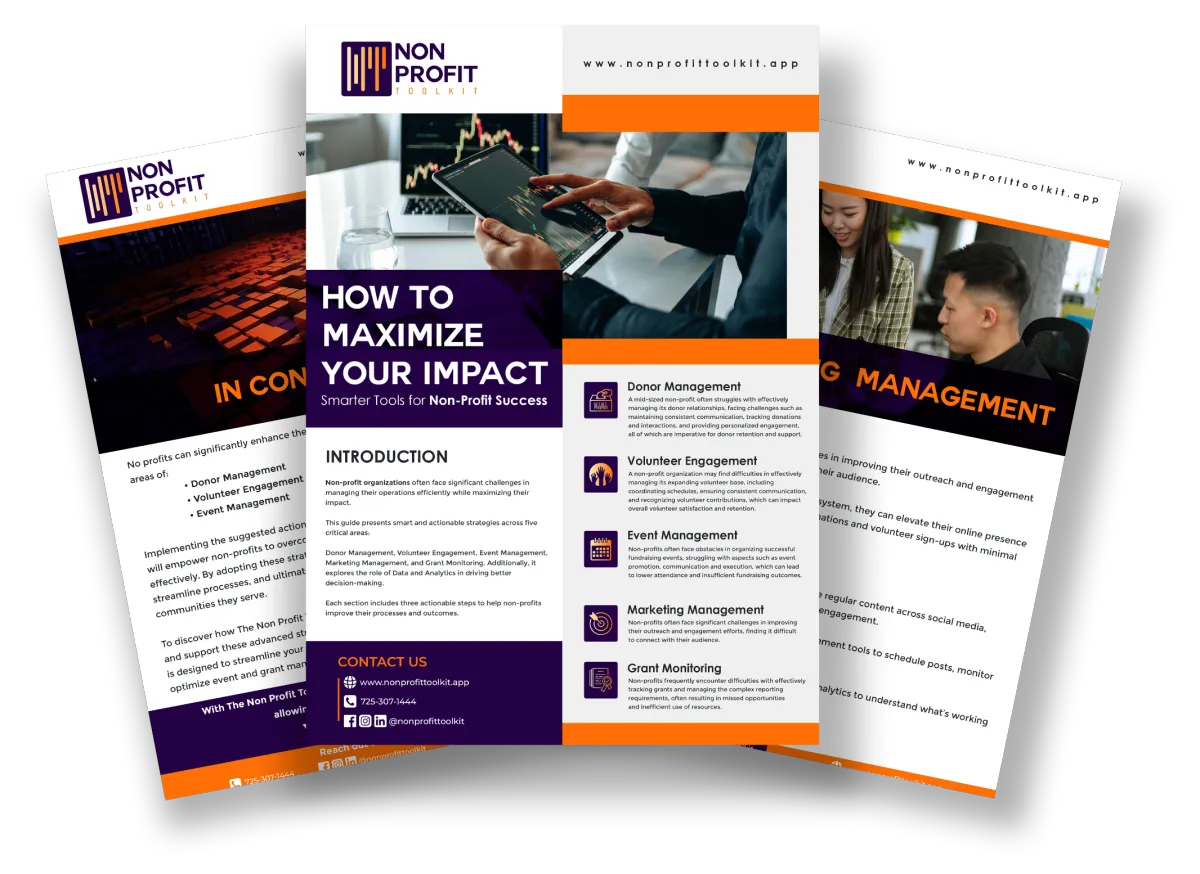
Download your copy now
and move your mission forward!
Ready to take your non-profit to the next level? Sign up now to receive our exclusive free guide packed with expert tips and strategies to help you:
Enhance your operational efficiency:
Unify your systems, saving time, and reducing stress.
Boost volunteer engagement:
Simplify processes that keep your team motivated and committed.
Build Stronger Donor Relationships:
Leading to increased support and long-term loyalty.
Manage Events and Fundraising:
Plan, promote, and execute fundraising events that exceed your goals.
Organize Grant & Sponsorship Opportunities:
Stay organized and meeting every deadline with confidence.

The Smart Way
to Manage Your Mission
FEATURED STORIES

How AI Implementation Empowers Nonprofit Teams
Artificial intelligence is transforming how mission-driven organizations operate. For nonprofits working with limited staff and budgets, AI can be a powerful ally, helping teams save time, gain insights, and focus more energy on serving communities. But adopting new technology also means rethinking how staff work, learn, and grow alongside it.
Why AI Matters in the Nonprofit Sector
AI helps nonprofits make smarter decisions with fewer resources. By automating repetitive tasks and turning data into actionable insights, organizations can spend more time building relationships and less time managing administrative details.
Examples of AI in action:
Feeding America uses AI to optimize food distribution, reducing waste and ensuring supplies reach the areas that need them most.
The Trevor Project employs AI chat analysis to support counselors by identifying high-risk messages in real time, enabling faster crisis responses.
WWF (World Wildlife Fund) uses AI-driven image recognition to monitor animal populations and detect illegal poaching activity.
These examples show that when nonprofits align AI tools with their mission, the technology amplifies their impact rather than distracting from it.
Supporting Staff Through the Transition
Staff are at the heart of any nonprofit’s success, so their adaptation to AI is key. Some may worry that automation could replace their roles, while others might feel overwhelmed by technical skills. The right approach is to position AI as a helper, not a replacement.
Practical steps to support staff:
Train employees according to their specific tasks and learning styles.
Encourage pilot projects led by mixed teams of staff, volunteers, and tech partners.
Celebrate successful AI wins, such as faster outreach or better data reporting.
Communicate openly about the reasons for adopting AI and how it benefits staff and communities.
By designing an inclusive adoption process, nonprofits can ensure everyone feels part of the innovation journey.
A People-First Approach to Technology
Successful AI implementation in nonprofits depends more on culture than on code. Leadership must model openness to learning, ethical responsibility, and collaboration. AI should enhance, not replace the empathy and creativity that drive meaningful change.
For instance, smaller community-based nonprofits have started using low-cost AI tools like chatbots or predictive analytics for donor engagement. These tools help small teams maintain personal connections while scaling outreach efforts.
Moving Forward with Purpose
AI offers nonprofits a powerful opportunity to work smarter and reach further. When leaders focus on people-first adoption, clear communication, and practical examples, technology becomes a natural extension of their mission. The future of nonprofit work is not just digital - it’s human and intelligent at the same time.

The Non Profit Toolkit powers non profits to focus on their mission
while efficiently managing their resources and growth.
A comprehensive management platform designed
to tackle the unique challenges faced by non-profit organizations.
By streamlining volunteer coordination, interactions with donors,
managing events, overseeing grant applications and sponsorship opportunities,
our platform ensures seamless operations and maximizes impact.
THE ALL-IN-ONE SOLUTION
TO HELP YOU AMPLIFY YOUR IMPACT
Donor Interations
Volunteer Engagement

Event Management

Marketing Management
Grant Monitoring

Reporting Analytics

GET IN TOUCH WITH US
PHONE: (725) 307-1444
Copyright © 2024 | All Rights Reserved | Terms and Conditions | Privacy Policy | Powered by: KMS Powered